
Hydrogen Leak Detection
Hydrogen Leak Detectors — A Proven Helium Alternative
For decades, helium mass spectrometry was the default benchmark for high-sensitivity tracer gas leak testing. Ongoing supply volatility and rising global costs have pushed manufacturers toward a scalable, technically equivalent alternative. Using forming gas — a standard, non-flammable mix of 5% hydrogen and 95% nitrogen — has emerged as one of the premier options, delivering exceptional sensitivity, rapid sensor recovery and strong economic sustainability.
The INFICON range of hydrogen leak detectors is a fully mature, well-proven technology. With decades of field-tested reliability, these detectors give manufacturers a robust, stable route to modern, efficient hydrogen-based quality assurance. And as the green energy sector and hydrogen economy expand, demand for reliable hydrogen leak detection — from fuel cell powertrains to industrial pipelines — has moved from routine check to safety and performance mandate.
▶ Hydrogen Leak Detector Comparison — XRS9012 vs Sensistor Sentrac
| Feature / Specification | Sensistor XRS9012 (Utility & Field) | Sensistor Sentrac Strix (Production & QC) |
|---|---|---|
| Primary target market | Utility networks, buried pipelines, telecom cables, heavy-duty field maintenance | Automotive assembly, HVAC/R manufacturing, battery testing, inline QC |
| Tracer gas medium | Forming gas 5% H2 / 95% N2 | Forming gas 5% H2 / 95% N2 |
| Form factor & housing | Handheld / shoulder-carried, waterproof aluminium casing (IP55) | Industrial console — desktop, panel-mount or portable |
| Max sensitivity | 0.7 ppm H2 in air (approx. 1×10⁻⁷ mbar·l/s) | 0.5 ppm H2 in air (approx. 1×10⁻⁷ mbar·l/s) |
| Response time | <1 second (sensor in probe tip) | <1 second (ultra-fast clearing Strix technology) |
| Start-up / warm-up | <10 seconds | 30 seconds |
| User interface | 10-level LED bar graph, internal speaker, 3.5mm headphone jack | Colour touchscreen HMI, on-screen numerical readouts, display-guided probe |
| Battery | ~13 hours at 20°C (rechargeable, 12V car charging) | 12–22 hours (Li-Ion), ~6.5 hour charge |
| Connectivity & I/O | Standalone analogue indicator | USB-C, RS232, probe control port, BM1000 communication module |
| Calibration | Manual baseline via dial / external leak verification | Digital auto-calibration via reference test leak |
| Weight | 1.9 kg (2.5 kg cased) | Desktop 3.5 kg / Portable 4.0 kg / Panel 2.2 kg |
Why Choose Hydrogen?
Moving to a hydrogen-based tracer gas addresses both macroeconomic and physical engineering challenges at once:
- Economic freedom from the helium crisis — helium is a finite, non-renewable byproduct of natural gas extraction, vulnerable to geopolitical shocks. Forming gas is readily synthesised, inexpensive and available worldwide, significantly lowering cost per test.
- Favourable molecular behaviour — hydrogen is the smallest, lightest molecule, with high velocity and low viscosity. It migrates through microscopic leak channels faster than helium, drastically shortening response times.
- Excellent background resilience — modern hydrogen leak detectors use highly selective solid-state sensors that excel at background compensation, so test areas don’t need extensive ventilation cycles before resuming.
Typical Hydrogen Leak Testing Applications
▶ View applications and standards
| Field | Application | Instrument | Standards |
|---|---|---|---|
| Clean energy & automotive | Fuel cell stacks, bipolar plates, hydrogen powertrains | Sensistor Sentrac (Strix) | ISO 20485, SAE J2579, ISO 19881 |
| Industrial valves & pipelines | Fugitive emissions, packing seal integrity | Sensistor Sentrac (Strix) | ISO 15848-1, API 622 / 624, ISO 20485 |
| HVACR & cooling | Evaporator & condenser coils, heat exchangers | Sensistor Sentrac (Strix) | ISO 14903, EN 378, ISO 20485 |
| Municipal & buried utilities | Underground water & gas distribution mains | Sensistor XRS9012 | ISO 20485, local utility codes |
| Telecommunications | Pressurised cable ducts, fibre-optic enclosures | Sensistor XRS9012 | ITU-T L.156 / L.10 series |
| Hydrogen infrastructure | Fuelling stations, storage tanks, distribution commissioning | XRS9012 (field) / Sentrac (OEM) | ISO 19880-1, ISO 15869, ISO 20485 |
Production Leader: INFICON Sensistor Sentrac
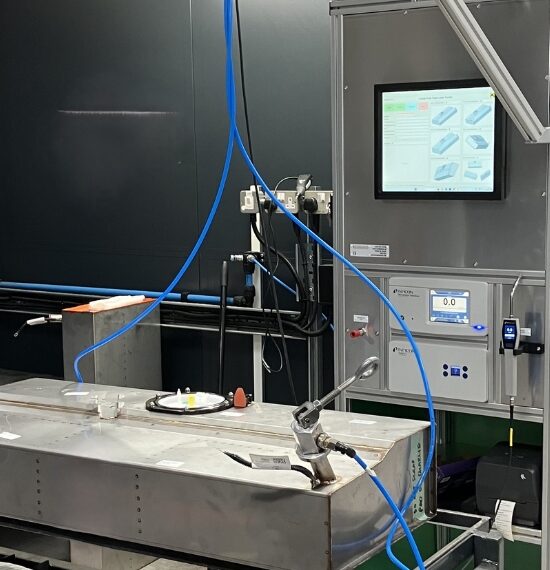
When high-throughput manual assembly or robot-assisted line testing sets your pace, the INFICON Sensistor Sentrac is the gold standard for core production hydrogen leak detection. Its proprietary Strix solid-state, hydrogen-selective sensor delivers two decisive advantages:
- Immunity to saturation — a wide dynamic range and rapid recovery let it instantly clear its baseline and detect a tiny micro-leak immediately after encountering a gross failure, where traditional detectors would be “poisoned”.
- Pump-less architecture — the sensor relies on natural gas diffusion rather than mechanical pumps, so there are no internal moving parts to wear or replace, giving an exceptionally low cost of ownership.
The Sentrac is available in desktop, panel-mount and portable battery configurations, and can be fitted with an R50 robotic probe for high-volume automotive lines.
Rugged Field Specialist: INFICON Sensistor XRS9012
Field service, buried utilities and heavy industrial networks demand a different level of physical resilience. Housed in a waterproof, heavy-duty aluminium casing rated to IP55, the INFICON Sensistor XRS9012 is built to withstand outdoor site maintenance — pressurised telecom ducts, buried water and gas pipelines, hydrogen-cooled generators and green-energy fuelling stations.
Weighing just 1.9 kg (2.5 kg cased), it includes a built-in sensitivity adjuster for weather, soil density and wind, and a hyper-efficient charge curve: 5 minutes from a 12V vehicle adapter yields up to 20 minutes of field sniffing.
Integrating Hydrogen Leak Testing Into Your Facility
Replacing qualitative water baths or unreliable soap-spray tests with quantitative forming-gas sniffing eliminates product drying times, reduces warranty claims and builds a fully digital, audit-ready quality ledger. Matching automated production tools like the Sensistor Sentrac with rugged field units like the XRS9012 keeps your operations compliant, cost-effective and technically defensible. Explore our related tracer gas leak testing capability, or talk to our team about the right configuration.
Frequently Asked Questions
Complex Testing Requirements?

