
Helium Leak Testing Service
Helium Leak Testing and Tracer Gas Services
Helium leak testing is the most sensitive practical method available for verifying the integrity of sealed components. Helium is inert, non-toxic, present in the atmosphere at only ~5 ppm, and has an exceptionally small molecule — so it migrates through leak paths that air-based methods cannot resolve, and any helium detected outside the part can be attributed to a genuine leak.
Optimeasure has provided tracer gas leak testing since 2003. We supply the instruments, integrate them into production lines, and deliver testing as a service where you need capability without capital outlay.
Tracer Gas Test Methods
▶ Which method suits your part?
| Method | How it works | Typical sensitivity | Best for |
|---|---|---|---|
| Vacuum (hard vacuum) | Part is evacuated inside a chamber; a mass spectrometer measures helium drawn through any leak | 10⁻⁴ to 10⁻⁷ mbar·l/s (to 10⁻¹² achievable) | Highest sensitivity; whole-part integrity; end-of-line automation |
| Accumulation | Part is charged with helium inside a sealed enclosure; helium concentration builds and is measured | 10⁻² to 9×10⁻⁴ mbar·l/s | Quantified leak rate without a hard vacuum system |
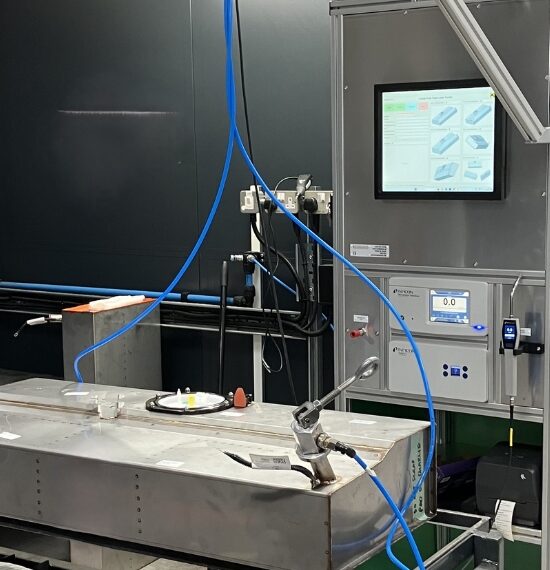
| Sniffing | Part is pressurised with helium; a probe is passed over the exterior to locate the leak | 10⁻³ to 10⁻⁷ mbar·l/s | Locating leaks; large or awkward assemblies; in-service testing |
| Bombing | Sealed part is pressurised in a helium environment, then tested for escaping helium | To 10⁻⁹ mbar·l/s | Hermetically sealed items with no test port |
Vacuum testing is quantitative — it tells you whether a part leaks and by how much. Sniffing is qualitative — it tells you where. The distinction matters beyond convenience: several standards are written around these definitions, so the method you choose may be dictated by the standard you are testing to. Many programmes use both — quantify first, then locate.
Standards We Test To
- ASTM F2391 — standard test method for measuring package integrity by helium tracer gas.
- ISO 20485 — non-destructive testing, leak testing, tracer gas method (superseded EN 1779).
- ISO 20486 — calibration of reference leaks for gases, underpinning traceable results.
- ISO 15848-1 — fugitive emissions classification for industrial valves.
See also our comparison of helium vs hydrogen leak detection.
When to Choose Tracer Gas Over Air
Air-based pressure decay leak testing is faster and cheaper per test, and is the right answer for the majority of production leak specifications. Tracer gas becomes the correct choice when:
- Your specification requires better than roughly 10⁻³ mbar·l/s, which is beyond the practical reach of air decay.
- The part volume is large, making air decay slow and thermally sensitive.
- You need to locate a leak, not just detect one.
- The part is hermetically sealed with no test port.
- Regulatory or customer requirements specify a tracer gas method.
Where helium cost or supply is a constraint, forming gas is a proven alternative — see hydrogen leak detection.
Industries We Serve
Automotive and EV (battery cooling, fuel systems, powertrain), aerospace (fuel tanks, hydraulics, hermetic connectors), medical device and pharmaceutical packaging, HVACR and refrigeration, semiconductor and vacuum equipment, and general industrial pressure and vacuum vessels.
Equipment Supply and Integration
Alongside the service, we supply the INFICON leak detector range and integrate systems into existing production lines and PLC environments, backed by traceable calibration and a UK-wide service network.
Frequently Asked Questions
Complex Testing Requirements?

